Glacier Meltdown: Another Scientific Scandal Involving the IPCC Climate Research Group By F. William Engdahl | |
URL of this article: www.globalresearch.ca/index.php?context=va&aid=17155 | |
Global Research, January 23, 2010 | |
Only days after the failed Copenhagen Global Warming Summit, yet a new scandal over the scientific accuracy of the UN IPCC 2007 climate report has emerged. Following the major data-manipulation scandals from the UN-tied research center at Britain's East Anglia Universitylate 2009, the picture emerges of one of the most massive scientific frauds of recent history. Senior members of the UN climate project, the Intergovernmental Panel on Climate Change (IPCC) have been forced to admit a major error in the 2007 IPCC UN report that triggered the recent global campaign for urgent measures to reduce “manmade emissions” of CO2. The IPCC's 2007 report stated, “glaciers in the Himalayas are receding faster than in any other part of the world.” Given that this is the world's highest mountain range and meltdown implies a massive flooding of India, China and the entire Asian region, it was a major scare “selling point” for the IPCC agenda. As well, the statement on the glacier melt in the 2007 IPCC report contains other serious errors such as the statement that “Its total area will likely shrink from the present 500,000 to 100,000 square kilometers by the year 2035." There are only 33,000 square kilometers of glaciers in the Himalayas. And a table in the report says that between 1845 and 1965, the Pindari Glacier shrank by 2,840 meters. Then comes a math mistake: It says that's a rate of 135.2 meters a year, when it really is only 23.5 meters a year. Now scientists around the world are scouring the entire IPCC report for indications of similar lack of scientific rigor. It emerges that the basis of the stark IPCC glacier meltdown statement of 2007 was not even a scientific study of melting data. Rather it was a reference to a newspaper article cited by a pro-global warming ecological advocacy group, WWF. The original source of the IPCC statement, it turns out, appeared in a 1999 report in the British magazine, New Scientist that was cited in passing by WWF. The New Scientist author, Fred Pierce, wrote then, “The inclusion of this statement has angered many glaciologists, who regard it as unjustified. Vijay Raina, a leading Indian glaciologist, wrote in a paper published by the Indian Government in November that there is no sign of "abnormal" retreat in Himalayan glaciers. India's environment minister, Jairam Ramesh, accused the IPCC of being "alarmist." The IPCC's chairman, Rajendra Pachauri, has hit back, denouncing the Indian government report as "voodoo science" lacking peer review. He adds that "we have a very clear idea of what is happening" in the Himalayas.” [1] The same Pachauri, co-awardee of the Nobel Prize with Al Gore, has recently been under attack for huge conflicts of interest related to his business interests that profit from the CO2 global warming agenda he promotes.[2] Pearce notes that the original claim made by Indian glaciologist Syed Hasnain, in a 1999 email interview with Pearce, namely that all the glaciers in the central and eastern Himalayas could disappear by 2035, never was repeated by Hasnain in any peer-reviewed scientific journal, and that Hasnain now says the remark was "speculative". Despite the lack of scientific validation, the 10-year-old claim ended up in the IPCC fourth assessment report published in 2007. Moreover the claim was extrapolated to include all glaciers in the Himalayas. Since publication of the latest New Scientist article, the IPCC officially has been forced to issue the following statement: “the IPCC said the paragraph "refers to poorly substantiated estimates of rate of recession and date for the disappearance of Himalayan glaciers. In drafting the paragraph in question, the clear and well-established standards of evidence, required by the IPCC procedures, were not applied properly." The IPCC adds, "The IPCC regrets the poor application of well-established IPCC procedures in this instance." But the statement calls for no action beyond stating a need for absolute adherence to IPCC quality control processes. "We reaffirm our strong commitment to ensuring this level of performance," the statement said.” [3] In an indication of the defensiveness prevailing within the UN's IPCC, Jean-Pascal van Ypersele, vice-chair of the IPCC, insists that the mistake did nothing to undermine the large body of evidence that showed the climate was warming and that human activity was largely to blame.He told BBC News: "I don't see how one mistake in a 3,000-page report can damage the credibility of the overall report." Some serious scientists disagree. Georg Kaser, an expert in glaciology with University of Innsbruck in Austria and a lead author for the IPCC, gave a damning different assessment of the implications of the latest scandal affecting the credibility of the IPCC. Kaser says he had warned that the 2035 prediction was clearly wrong in 2006, months before the IPCC report was published. "This [date] is not just a little bit wrong, but far out of any order of magnitude. All the responsible people are aware of this weakness in the fourth assessment. All are aware of the mistakes made. If it had not been the focus of so much public opinion, we would have said 'we will do better next time'. It is clear now that working group II has to be restructured." [4] The chairman of the IPCC, Rajendra Pachauri, has made no personal comment on the glacier claim. It appears he is as well shaken by the wave of recent scandals. He told a conference in Dubai on energy recently, "They can't attack the science so they attack the chairman. But they won't sink me. I am the unsinkable Molly Brown (sic). In fact, I will float much higher," he told the Guardian. His remarks suggest more the ‘spirit of Woodstock' in 1969 than of what is supposed to be the world's leading climate authority. F. William Engdahl is the author of Full Spectrum Dominance: Totalitarian Democracy in the New World Order Notes [1] Fred Pearce, Debate heats up over IPCC melting glaciers claim, 11 January 2010, accessed in http://www.newscientist.com/article/dn18363-debate-heats-up-over-ipcc-melting-glaciers-claim.html?DCMP=OTC-rss&nsref=online-news. [2] F. William Engdahl, UN IPCC Climate Change chief in Conflict of Interest Scandal, December 27, 2009. [3] Seth Borenstein, UN climate report riddled with errors on glaciers, AP, January 20, 2010. [4] Ibid. | |
Sunday, January 24, 2010
Another Scientific Scandal Involving the IPCC Climate Research Group

Tuesday, January 12, 2010
The Chávez Spiral
 |
Venezuelan dictator Hugo Chávez is losing altitude fast. Since his election in 1998 he's proved a deft manager of chaos--an oil strike, fierce political opposition, an army rebellion, food shortages, etc. He has been kept aloft by doling out oil revenues to satisfy the poor majority that forms his loyal base, to blunt the effects of economic mismanagement and to buy off the military and collaborating oligarchs, who reap the benefits of government sweetheart deals.
With petroleum prices down around $71 a barrel from a high of $147 the Venezuelan government is struggling to make up for the revenue shortfall to save programs that placate the poor by providing cheap food, fuel and other government giveaways. Making matters worse, the once mighty Venezuelan petroleum industry has been laid low by politicization, corruption and mismanagement; rather than producing 3.3 million barrels per day, industry analysts believe the production is closer to 2.3 million. Instead of maximizing profits by producing its quota, Venezuela's state-run oil fields are either underperforming or have collapsed altogether. Refining capacity also is in steep decline so Venezuela must import gasoline to meet internal needs--buying it at the market rate, selling it to domestic consumers at the much lower subsidized price and eating the difference.
Since late November, the Venezuelan state has had to intervene in about 10 banks, several of which were operated by Chavista cronies. These banks were favored by the regime to handle billions in Venezuelan government deposits. According to published accounts, these alleged crooked bankers were supposed to squirrel away these billions for Chávez, his family, government ministers, loyal military officers and other accomplices of his criminal regime. Instead, they stole and squandered the funds and came under the watchful eye of international regulators who have begun to freeze accounts in foreign banks. Chávez has moved in to scrape what is left of the cash and control the damage to the banking sector.
As for life itself, Caracas has become by far the most dangerous city in South America. . .
These related crises are mounting; the economy shrank 3% last year, inflation has risen to at least 25% today and the regime is running out of band-aids.
On Saturday, Chávez was forced to order a drastic devaluation in the national currency, which he hopes will relieve the government's budget woes. Under his plan, some basic necessities are supposed to remain available at a lower exchange rate, with other goods becoming twice as expensive. Critics say this dual system invites corruption and distorts the marketplace, while inflation is expected to rise another 3% to 5% and consumers will find it increasingly difficult to obtain imported goods.
Adding to the economic crisis is a drastic shortage of electricity. Last month Chávez ordered a rationing scheme after the state-run power company predicted a "national collapse" in April. He blames the crisis on a drought that has sapped the country's hydroelectric plant in the Guri Dam on the Caroní River. The problem is petroleum-fueled generators are failing too, with turbines lacking adequate fuel or shut down in disrepair. The electricity shortage is the result of gross mismanagement and underinvestment in the power sector to meet demand that has grown by 40% since 2002. Some experts say an $18 billion, multiyear modernization is required just to meet current needs.
The Venezuelan people also are enduring routine food shortages due to price controls that have discouraged domestic production and Chávez's repeated interruptions in trade with neighboring Colombia, upon which Venezuelans are increasingly dependent for consumer goods. With the blackouts disrupting domestic production and the currency devaluation, Venezuelans can expect increasing scarcity of the basic necessities of life.
As for life itself, Caracas has become by far the most dangerous city in South America; In September 2008 Foreign Policy magazine listed it among the "murder capitals of the world," noting that the homicide rate had grown by 67% since Chávez took power, even according to suspect official statistics. Chávez governs through cronyism and corruption to reward his friends and harass his opponents. His regime also conspires with drug traffickers who fuel criminal gangs that prey on innocent Venezuelans. This culture of lawlessness has gutted the police force and courts and undermined the quality of life of every citizen, rich or poor.
In the past, Chávez has been able to throw money at problems--to placate a restless public, suborn the military, turn out loyal mobs or overwhelm an opposition campaign. However, it is impossible to rebuild massive power generators, a professional police force, honest courts, crumbling roads and bridges from one day to the next. It also would take years to restore private food production and transportation capacity, even if the regime were to reverse its relentless hostility to the free market.
Although the Venezuelan people have found life increasingly unbearable, many of them have come to depend on the patronage of a strong state or remain suspicious of the traditional political leaders who have yet to present a viable alternative to Chávez.
While the regime scrambles to deal with the crises of its own making, this would be an opportune time for the democratic opposition to issue a pledge to restore Venezuela:
- The rule of law must return, beginning with an offensive against crime, the professionalization of the police and the courts and accountability of the state before the people.
- International giveaways to Chávez's client states must end, and funds should be returned to the Venezuelan people.
- Billions in stolen revenues must be recovered, which shall be used to rebuild the nation's crumbling infrastructure and to restore the oil industry.
- Collusion with drug traffickers, terrorist groups and criminal gangs that are waging war against Venezuelans and their neighbors must stop.
- Military and other security officials must be loyal to the nation rather than a destructive political project.
- Cubans, Iranians and other foreigners who are exploiting Venezuela must leave the country.
- No young Venezuelan should lose his or her life to wage war with Colombia, and peaceful ties will be cultivated with all democratic nations.
- A government of national unity, reconciliation and reconstruction must be built upon free and honest elections, beginning with election of a new National Assembly this year.
The only thing worse than a dictator is an incompetent one. Every day, more Venezuelans must recognize that that the current systemic crisis is unbearable, unsustainable and, if they say so, unnecessary. Chávez's engines are sputtering--the only question is whether Venezuelans are prepared to crash and burn with his regime.
Roger F. Noriega is a visiting fellow at AEI
Monday, January 11, 2010
Why AIPAC Took Over Brookings
The following is an excerpt from Foreign Agents: The American Israel Public Affairs Committee From the 1963 Fulbright Hearings to the 2005 Espionage Scandal
Martin Indyk, an Australian and naturalized US citizen, is the former deputy director of research at the American Israel Public Affairs Committee. Indyk helped establish the Washington Institute for Near East Policy (WINEP) in 1984 with the support of AIPAC board member and activist Barbi Weinberg. Weinberg “had for over a decade privately wrestled with the idea of creating a foreign policy center.”1 After the establishment of WINEP, Indyk stated that he was still dissatisfied and wished to establish an institution capable of escaping AIPAC’s reputation as a “strongly biased organization.”1 Indyk would later go on to found the Saban Center for Middle East Policy at the Brookings Institution. The center was initially funded by a $13 million grant from Israeli dual citizen and television magnate Haim Saban,2 famously quoted by the New York Times as saying, “I’m a one-issue guy and my issue is Israel.”3 He also funded and established the Saban Institute for the Study of the American Political System within the University of Tel Aviv.4
WINEP’s role within the AIPAC power constellation is clear. While AIPAC lobbies with brute force for yearly aid allocations and enforces adherence to Israeli doctrine in Congress, WINEP polishes and shines Israeli policy objectives as pure expressions of US foreign policy interests. AIPAC is secretive about its internal deliberations and activities, but the highly sociable WINEP cultivates the image of a serious group of objective “scholars and wonks” deliberating Middle East policies in a rigorously academic fashion. WINEP not only hosts symposiums and conferences, but also conducts closed-door meetings with US politicians and distributes books and other publications rich in toned-down AIPAC ideology.
While AIPAC officials are loath to do live media events, especially with call-in or other potentially interactive audience segments, WINEP analysts and authors are omnipresent across major news- and policy-oriented programs. However, media announcements rarely mention WINEP’s overlap with AIPAC and other members of the Israel lobby or its close connections to Israel, although this would provide listeners and viewers with useful context for understanding the organization’s sophisticated positions. WINEP is also a place for grooming future presidential appointees, and it is perceived as a less controversial and more credible stepping stone to power than AIPAC.
Although AIPAC does not list WINEP as an affiliate in its IRS filings, in 2004 26% of AIPAC’s board of directors were also trustees of WINEP.5
WINEP’s ability to place stories that sway American public opinion toward supporting Israeli objectives is quantitatively revealed by analyzing the number of print media stories developed from WINEP content and analysts over a period of five critical years. Access, rather than merit or quality of content, drives WINEP’s news media success, according to former Middle East Studies Association President Joel Beinin:
While Aipac targets Congress through the massive election campaign contributions that it coordinates and directs, Winep concentrates on influencing the media and the executive branch. To this purpose it offers weekly lunches with guest speakers, written policy briefs, and “expert” guests for radio and television talk shows. Its director for policy and planning, Robert Satloff; its deputy director, Patrick Clawson; its senior fellow, Michael Eisenstadt, and other associates appear regularly on radio and television.Winep views prevail in two weekly news magazines,US News and World Report and The New Republic(whose editors-in-chief, Mortimer Zuckerman and Martin Peretz, sit on Winep’s board of advisers). The views of Winep’s Israeli associates, among them journalists Hirsh Goodman, David Makovsky, Ze’ev Schiff and Ehud Ya’ari, are spoon-fed to the American media.6
An analysis of major print coverage of WINEP-attributed content between the years 2001 and 2006 reveals that WINEP is not always engaged in a full-on media blitz. Rather, its media power is exercised cyclically as initiatives are strategically “brought to market.” In 2002, WINEP went on the offensive, tying the 9/11 terrorist attacks on the US to Israel’s own efforts to subdue Palestinians and making a broad and vitriolic call for a greater US military role in the Middle East. Using the ProQuest print media database citations as an index, WINEP boosted war messaging media placements by 7%. In 2002-2003, AIPAC went into overdrive, secretly working Congress to support the ill-fated invasion of Iraq based on “weapons of mass destruction” and other pretexts. WINEP “analysts” began an all-out media blitz to “substantiate pretexts” and urge a hasty US military invasion of Iraq in the face of global opposition. Dennis Ross, the ubiquitous director of WINEP, eloquently appealed for public rejection of containment and other measures short of immediate US military invasion in a typical Baltimore Sun op-ed on March 13, 2003:
Sooner or later, Mr. Hussein, with nukes, would miscalculate again, making the unthinkable in the Middle East all too likely.
Some might reasonably argue that there are better ways to ensure he does not acquire nuclear weapons. Enhanced containment, with open-ended and intrusive inspections, could prevent Mr. Hussein from acquiring or developing these weapons. True, but is such a regime realistic? When the Bush administration came to power, the existing containment regime was fraying.
The alternative of war has made France a convert to enhanced containment for the time being. It has also provided Mr. Hussein an incentive to grudgingly, and always at the last minute, take the minimal steps required to keep us at bay.
Does anyone believe that in the absence of more than 200,000 U.S. troops in the area Mr. Hussein would be taking even his minimal steps? How long would he continue to “cooperate” if the troops weren’t there? How long would the French insist on intrusive inspections if we weren’t on the brink of war? And how long can we keep such a large military presence in the area?
The unfortunate truth is that we cannot maintain a war footing indefinitely. The paradox is that our large-scale military presence creates the potential to contain Iraq, but it is sustainable neither from our standpoint nor from the standpoint of the region. Either we will use it to disarm Mr. Hussein or we will within the next few months have to withdraw it. And once we began to remove it, several new and dangerous realities would emerge.7
The WINEP media placement index reveals a jump from 611 to 672 between the year 2002 and 2003 — a 10% increase in mainly Iraq-invasion-focused media placements.
WINEP Media Placement Index
(Source: ProQuest Print Database Search)

(Source: ProQuest Print Database Search)
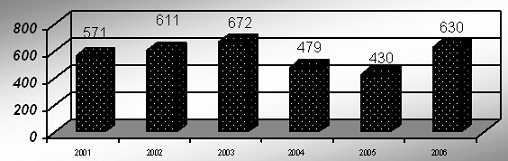
In the post-invasion fallout after public discovery that weapons of mass destruction were not the imminent threat to the US that had been portrayed by WINEP and many other operatives, WINEP saw no need to maintain a “surge”-level media blitz. The mission of getting US troops into Iraq, mirroring Israel’s own occupation of Palestinian territories, had been accomplished.
However, the post-invasion index jump from 430 to 630 indicates that WINEP is again on a mission. It is no secret that the new military objective is Israel’s arch-nemesis, Iran. Although the US public is vastly more skeptical about the claims of war partisans, the 47% increase in Iran-centric WINEP media placements should be understood as a leading indicator of military conflict in 2008 if WINEP and AIPAC meet their objectives. Given the elite status and political muscle of WINEP trustees, the efforts of AIPAC’s think tank should not be underestimated, especially in an election year. WINEP meets before the entry of a new president to debate and draft the administration’s Middle East “blueprint.” Many WINEP trustees believe that this policy mandate affecting all Americans is the prerogative of its handpicked commission members, including officials of the Israeli military establishment. Brian Whitaker of The Guardian questioned whether any other foreign principal could accomplish the same maneuver.
The Washington Institute is considered the most influential of the Middle East think tanks, and the one that the state department takes most seriously. Its director is the former US diplomat, Dennis Ross.
Besides publishing books and placing newspaper articles, the institute has a number of other activities that for legal purposes do not constitute lobbying, since this would change its tax status.
It holds lunches and seminars, typically about three times a week, where ideas are exchanged and political networking takes place. It has also given testimony to congressional committees nine times in the last five years.
Every four years, it convenes a “bipartisan blue-ribbon commission” known as the Presidential study group, which presents a blueprint for Middle East policy to the newly-elected president.
The institute makes no secret of its extensive links with Israel, which currently include the presence of two scholars from the Israeli armed forces.
Israel is an ally and the connection is so well known that officials and politicians take it into account when dealing with the institute. But it would surely be a different matter if the ally concerned were a country such as Egypt, Pakistan or Saudi Arabia.8
AIPAC’s influence in the US news media leads to curious and generally unnoticed subsidiary alumni reunions. On June 14, 2007, following a Hamas takeover of Palestinian installations in Gaza, Wolf Blitzer invited Dennis Ross into the CNN situation room to give his perspective on the instability. Customarily, Dennis Ross’s new book and WINEP affiliation were mentioned; AIPAC and the pervasive Israel connection were not. Equally unmentioned were Wolf Blitzer’s former career as a reporter and editor of the Near East Report (AIPAC’s newsletter) in the 1970s or his authorship of a comprehensive apologia downplaying the damage caused to the US by Jonathan Pollard’s spying for Israel in his book Territory of Lies.9
Although WINEP’s media influence is growing, compared to other think tanks, AIPAC’s ability to place public policy messages in the news media through WINEP was comparatively limited until 2002. Thanks to a timely “acquisition,” AIPAC and WINEP can now count on broader promulgation of AIPAC policy ideas through the Brookings Institution, one of the oldest and most highly regarded public policy think tanks in the United States.
The Saban Center for Middle East Policy
Brookings Institution Middle East policy research was placed under the direction of former AIPAC deputy director for research Martin Indyk in May of 2002. In an Internet video presenting the Saban Center, Indyk vastly understates both Haim Saban’s biography and his contribution to Brookings by referring to it as merely the “generosity of a Los Angeles businessman.” In 2006, Forbes magazine more accurately described Saban as the 98th richest person in America and the “Egyptian-born, Israeli-raised, now-American cartoon king.”10Indyk does not, however, understate how assembling hand-picked researchers to produce tightly messaged policy research can be thought of as “a business” in his Saban Center introductory video.
Haim Saban, a, uh, businessman in Los Angeles, came to Brookings with a desire to see us do more work on the Middle East issue. On the issues of the peace process, and terrorism, and the spread of weapons of mass destruction, and energy issues. And, uh, was prepared to put up the funds to get the center started. Through Haim Saban’s generosity, we are now able to launch a much larger effort to promote innovative policies, research and analysis that brings together the best minds in the business.11
It is useful to carry Indyk’s “business” analogy a bit further. In 2003, Haim Saban led the $5.7 billion purchase of Kirch Media Group; in 2001, News Corporation and Saban sold Fox Family Worldwide for $5.1 billion. Saban was part of an investor group that won the bid for Univision, the biggest Spanish-language media corporation in the United States, in June of 2006. Financially speaking, Saban’s $13 million Brookings investment secured control over one of the most financially robust as well as influential policy think tanks. In 2005, the Brookings Institution’s net assets totaled $269,660,363.12 From Saban’s perspective as a savvy media player concerned with promoting the policies of Israel’s government, taking over Brookings Middle East policy by launching the Saban Center in 2002 was yet another sound and extremely timely business investment — this time, in the marketplace of ideas. According to 2002 research by media watchdog Fairness and Accuracy in Reporting, Brookings led think tanks in total US media influence, measured by the number of policy analyst and report citations appearing in major US media.
Think Tank Share: US Marketplace of Policy Ideas
(Source: Fairness and Accuracy in Reporting)

(Source: Fairness and Accuracy in Reporting)

By targeting and taking over Middle East policy at Brookings in 2002, Saban and Indyk were able to “leapfrog” AIPAC messaging from second to last in the think tank market (WINEP had only 2%) to first place. Taking over Brookings also made it appear to Americans that there was now an “expert consensus” from “right to left” on the key Middle East policy issue of the year: the US invasion of Iraq on weapons of mass destruction pretexts. Brookings is often portrayed as a “centrist to left think tank” in the corporate news media. According to FAIR, “Progressive or Left-Leaning” media citations were a small but important segment of the marketplace of ideas, but combined with “centrist,” they represented the majority. For Saban and Indyk, taking over Brookings Middle East policy in 200213 meant penetrating the 63% of the marketplace of ideas that was generally not beating a drum for war in Iraq.
US Think Tank Policy by Political Ideology
(Source: Fairness and Accuracy in Reporting)

(Source: Fairness and Accuracy in Reporting)
The arguments in favor of the Iraq invasion in the many Saban Center articles appearing across major newspapers, such as “Lock and Load” by Martin Indyk and Kenneth M. Pollack, Director of Research at Saban, did not differ in message from those of AIPAC’s own Washington Institute for Near East Policy and Dennis Ross. It would have been odd if they did, since, like Indyk, Kenneth Pollack worked at WINEP as a “research fellow” specializing on Iraq.14
Rather, the Bush administration could take the time it needs to “study” the Iraqi declaration, discussing its falsehoods and fabrications with allied governments until it has lined up all the necessary political and military ducks. Once the best case has been made and the preparations completed (probably in a few weeks), President Bush could announce that, in accordance with United Nations Resolution 1441, we and our allies have concluded that Iraq is in material breach of the 1991 cease-fire resolution and therefore the U.S. will lead a coalition to disarm Iraq by force.
If there must be war, this is the best way. The problem with allowing the inspections to play themselves out is that it is a policy based on hope, and as Secretary of State Colin Powell is fond of saying, “hope is not a plan.”
There is real risk in allowing the inspections to run on indefinitely. The longer the inspections go on and find nothing, the harder it will be for the U.S. to build a coalition when we finally decide to take action.15
The takeover of Brookings Middle East policy by an AIPAC operative and Israeli-American businessman represents an evolution in AIPAC influence over think tanks. From a business perspective, AIPAC has moved from “investment in startups” to “establishing subsidiaries” to the more recent stage of “corporate takeovers and acquisitions.” AIPAC has evolved strategically as a result of success and failure. Financing Dr. Benjamin Shwadran’s highly academic policy research at the Council on Middle East Affairs with Jewish Agency funding laundered through the Rabinowitz Foundation was problematic and nearly crumbled under the glare of Fulbright’s 1963 Senate probe. Even setting up the Washington Institute for Near East Policy in 1984 with AIPAC donor funds and board member involvement still did not give AIPAC the desired influence level of other less “captive” think tanks, particularly in the US news media. The takeover of Middle East policy at Brookings achieved what AIPAC had long sought in the marketplace of public policy: prestige, ideological spectrum dominance, and the highest level of achievable corporate media placement for its public policy initiatives. The American people are now more susceptible than ever before to AIPAC’s “weapons of mass destruction” propaganda campaigns and other targeted media messages emanating from its right, left, and center public policy “think tanks.” AIPAC and Saban are apparently convinced that the same messages can be effectively rebranded and simultaneously broadcast from both WINEP and Brookings. “Lock and Load” co-author Kenneth Pollack proved this during media appearances on CNN and Fox News in which he was successfully positioned as a liberal Bush Iraq war critic gradually coming to see the wisdom of the US military occupation, as documented by news watchdog Media Matters:
During the July 30 edition of CNN Newsroom, anchor Heidi Collins introduced Kenneth Pollack of The Brookings Institution by saying that Pollack “has been a vocal critic of the administration’s handling of the [Iraq] war, but he says that an eight-day visit has changed his outlook a bit.” Collins also said that Pollack’s “tune is changing a bit” with respect to the war. Pollack went on to discuss how a recent visit to Iraq has left him “more optimistic” about the war. However, while focusing on Pollack’s criticisms of the “handling” of the war, Collins failed to note that Pollack was an influential proponent of the Iraq invasion before it happened, leaving viewers with the impression that Pollack was a war opponent who has become more supportive of the war. Pollack’s 2002 book on the subject was titled The Threatening Storm: The Case for Invading Iraq.16
Saban and AIPAC can be confident that few of the message’s target viewing population knew about Pollack’s record or key financial backer. They can also count on a new generation of eager AIPAC activists to populate think tanks and congressional offices in coming years thanks to “Saban Training” at AIPAC.
This summer GDI is proud to send two of its members to the American Israel Public Affairs Committee (AIPAC), Saban Training. On July 22, Joshua Sussman and Jen Sovronsky will travel to Washington, DC for 4 days of intense advocacy training.
The Saban conference is AIPAC’s premier student political leadership training seminar, presented through its Schusterman Advocacy Institute, is held twice each year in Washington, D.C. More than three hundred of AIPAC’s top student activists from over 100 campuses participate in three days of intense grassroots political and advocacy training. During this seminar, students meet with top Washington policy makers, elected officials, and Middle East experts.17
However, even as Saban advocacy training and activities continue in Washington, the potentially explosive outcome of a criminal trial across the Potomac in the Eastern District Court of Virginia could change the way many Americans view AIPAC.
- Mark Milstein, Washington Report on Middle East Affairs, July 1991. [↩] [↩]
- Grant F. Smith, “Israel Lobby Initiates Hispanic Strategy.” [↩]
- Andrew Ross Sorkin, New York Times, September 5, 2004. [↩]
- Phyllis Berman, Forbes Magazine, December 8, 2006. [↩]
- AIPAC Board Members on WINEP’s Board as listed in 2004 IRS form 990 filings include Robert Asher, Paul Baker, Edward Levy, Mayer Mitchell, Larry Mizel, Lester Pollack, Nina Rosenwald, Eugene Schupak, Roseelyne Swig, James Tisch, Larry Weinberg, Tim Wurlinger and Harriet Zimmerman. [↩]
- Joel Beinin, Le Monde Diplomatique, July 2003. [↩]
- Ross, Dennis, Baltimore Sun, March 19, 2003. [↩]
- Brian Whitaker, The Guardian, August 19, 2002. [↩]
- Territory of Lies: The Exclusive Story of Jonathan Jay Pollard: The American Who Spied on His Country for Israel and How He Was Betrayed [↩]
- Forbes Magazine, September 21, 2006. [↩]
- Director’s Introductory Video, Brookings Saban Center Website. [↩]
- Brookings Institution form 990 filing for its fiscal year ending June 30, 2005. [↩]
- Brookings Saban Center Website. [↩]
- Profile of Pollack from the WINEP website archive [↩]
- Martin Indyk, Los Angeles Times, December 19, 2002. [↩]
- Media Matters, July 30, 2007. [↩]
- University of Albany community website. [↩]
Sunday, January 3, 2010
7-year plan aligns U.S. with Europe's economy
THE NEW WORLD DISORDER
Rules, regs to be integrated
without congressional review
Rules, regs to be integrated
without congressional review
By Jerome R. Corsi
© 2009 WorldNetDaily.com
© 2009 WorldNetDaily.com
 German Chancellor Angela Merkel, President Bush and European Commission President Jose Manuel Barroso at a White House summit meeting last April where they launched the Transatlantic Economic Council |
Six U.S. senators and 49 House members are advisers for a group working toward a Transatlantic Common Market between the U.S. and the European Union by 2015.
The Transatlantic Policy Network – a non-governmental organization headquartered in Washington and Brussels – is advised by the bi-partisan congressional TPN policy group, chaired by Sen. Robert Bennett, R-Utah.
The plan – currently being implemented by the Bush administration with the formation of the Transatlantic Economic Council in April 2007 – appears to be following a plan written in 1939 by a world-government advocate who sought to create a Transatlantic Union as an international governing body.
An economist from the World Bank has argued in print that the formation of the Transatlantic Common Market is designed to follow the blueprint of Jean Monnet, a key intellectual architect of the European Union, recognizing that economic integration must inevitably lead to political integration.
(Story continues below) WND previously reported, a key step in advancing this goal was the creation of the Transatlantic Economic Council by the U.S. and the EU through an agreement signed by President Bush, German Chancellor Angela Merkel – the current president of the European Council – and European Commission President Jose Manuel Barroso at a White House summit meeting last April.
Writing in the Fall 2007 issue of the Streit Council journal "Freedom and Union," Rep. Jim Costa, D-Calif., a member of the TPN advisory group, affirmed the target date of 2015 for the creation of a Transatlantic Common Market.
Costa said the Transatlantic Economic Council is tasked with creating the Transatlantic Common Market regulatory infrastructure. The infrastructure would not require congressional approval, like a new free-trade agreement would.
Writing in the same issue of the Streit Council publication, Bennett also confirmed that what has become known as the "Merkel initiative" would allow the Transatlantic Economic Council to integrate and harmonize administrative rules and regulations between the U.S. and the EU "in a very quiet way," without introducing a new free trade agreement to Congress.
 Sen. Robert Bennett, R-Utah |
No document on the TEC website suggests that any of the regulatory changes resulting from the process of integrating with the EU will be posted in the Federal Register or submitted to Congress as new free-trade agreements or as modifications to existing trade agreements.
In addition to Bennett, the advisers to the Transatlantic Policy Network includes the following senators: Thad Cochran, R-Miss.; Chuck Hagel, R-Neb.; Barbara Mikulski, D-Md.; Pat Roberts, R-Kan.; and Gordon Smith, R-Ore.
Among the 49 U.S. congressmen on the TPN's Congressional Group are John Boehner, R-Ohio; John Dingell, D-Mich.; Kenny Marchant, R-Texas; and F. James Sensenbrenner, R-Wisc.
WND contacted Bennett's office for comment but received no return call by the publication deadline.
A progress report on the TEC website indicates the following U.S. government agencies are already at work integrating and harmonizing administrative rules and regulations with their EU counterparts: The Office of Management and Budget, the Food and Drug Administration, the Environmental Protection Agency, the Occupational Safety and Health Administration and the Securities and Exchange Commission.
A step toward world government
The Streit Council is named after Clarence K. Streit, whose 1939 book "Union Now" called for the creation of a Transatlantic Union as a step toward world government. The new federation, with an international constitution, was to include the 15 democracies of U.S., UK, France, Australia, Belgium, Canada, Denmark, Finland, the Netherlands, Ireland, New Zealand, Norway, Sweden, Switzerland and South Africa.
Ira Straus, the founder and U.S. coordinator of the Committee on Eastern Europe and Russia in NATO, a group dedicated to including Russia within NATO, credits Bennett as TPN chairperson with reviving Streit's work "seven decades later."
A globalist with leftist political leanings, Straus was a Fulbright professor of political science at Moscow State University and the Moscow State Institute of International Relations from 2001 to 2002.
The congruity of ideas between Bennett and Streit is clear when Bennett writes passages that echo precisely goals Streit stated in 1939.
One example is Bennett's claim in his Streit Council article that creating a Transatlantic Common Market would combine markets that comprise 60 percent of world Gross Domestic Product under a common regulatory standard that would become "the de facto world standard, regardless of what any other parties say."
Similarly, Streit wrote in "Union Now" that the economic power of the 15 democracies he sought to combine in a Transatlantic Union would be overwhelming in their economic power and a clear challenge to the authoritarian states then represented by Nazi Germany and the communist Soviet Union.
Also writing in the Fall 2007 issue of the Streit Council journal "Freedom and Union," World Bank economist Domenec Ruiz Devesa openly acknowledged that "transatlantic economic integration, though important in itself, is not the end."
"As understood by Jean Monnet," he continued, "economic integration must and will lead to political integration, since an integrated market requires common institutions producing common rules to govern it."
Transatlantic Common Market by 2015
Last February, the Transatlantic Policy Network formed a Transatlantic Market Implementation Group to put in place "a roadmap and framework" to direct the activity of the Transatlantic Economic Council to achieve the creation of the Transatlantic Common Market by 2015.
The Transatlantic Economic Council is an official international governmental body established by executive fiat in the U.S. and the EU without congressional approval or oversight. No new law or treaty was sought by the Bush administration to approve or implement the plan to create a Transatlantic Common Market.
The U.S. congressmen and senators are involved only indirectly, as advisers to the influential non-governmental organization.
In a February 2007 document entitled "Completing the Transatlantic Market," the TPN's Transatlantic Market Implementation Group writes, "The aim of this roadmap and framework would be to remove barriers to trade and investment across the Atlantic and to reduce regulatory compliance costs."
The document further acknowledged the impact the Transatlantic Common Market agenda would have on U.S. and European legislators: "The roadmap and framework will necessarily oblige legislative and regulatory authorities in both Europe and the United States to take into consideration from the outset the impact their acts may have on transatlantic economic relations and to ensure that their respective governmental bodies involved have the necessary budgetary and organizational resources to work closely with each other."
Clinton administration roots
The work to create a Transatlantic Common Market can be traced back to the Clinton administration's decision to join in the 1995 New Transatlantic Agenda with the European Commission.
Today, the website of the Transatlantic Economic Council openly proclaims the TEC is "a political body to oversee and accelerate government-to-government integration between the European Union and the United States of America."
The first meeting of the TEC was held Nov. 9 in Washington, D.C., and the next meeting is scheduled for June.
A joint statement issued at the Nov. 9 meeting specified progress was being made "in removing barriers to trade and investment and in easing regulatory burdens" in a wide range of policy areas, including drugs and disease control, the importation into the EU of U.S. poultry treated with pathogen reduction treatments, federal communication commissions allowing suppliers to create declarations of conformity for products, uniform standards for electrical products and agreements on standards for pure biofuels.
Subscribe to:
Comments (Atom)
